

At A Glance
Lisbon has no beach inside the city, but seven of Portugal’s best are between 20 and 60 minutes away, and most are reachable by train for the price of a coffee.
- Carcavelos is the closest proper beach, about 18 km out and roughly 30 minutes by train from Cais do Sodré.
- The Cascais train line runs along the coast and takes you to five different beaches on one ticket.
- Costa da Caparica sits across the Tagus and has 30 km of sand, far emptier than the Cascais side.
- Guincho is for wind and surf, not for swimming with small children.
- Staying central in Lisbon and day-tripping out beats basing yourself at one beach.
The single most common question we get from guests before they arrive is whether Lisbon has a beach. The short answer is that the city itself does not, because it sits on a river rather than the sea, and the honest longer answer is that this barely matters. Within an hour of the centre there are enough beaches to fill a fortnight, and the train that reaches most of them leaves from a station you can walk to from Casa Almada, our apartment in the middle of the city.
This guide covers the beaches and coastal towns that are genuinely worth the trip in 2026, how long each one actually takes to reach, which suit families and which do not, and where to stay so you are not tied to a single stretch of sand. If you are still deciding on a neighbourhood first, our guide to where to stay in Lisbon covers the city itself.
Everything here is measured from central Lisbon. Where a beach is difficult with young children or hard to reach without a car, I have said so rather than leaving it out.
Lisbon Beaches Compared: Distance, Transport and Who They Suit
Start here. This is the table I would want if I were planning the week, and it saves the usual mistake of picking a beach by photograph and discovering it is a two-bus journey with a pushchair.
| Town / beach | From Lisbon | Getting there | Family-friendly | Where to stay |
|---|---|---|---|---|
| Carcavelos | ~18 km, 30 min | Cascais train line | Yes, wide and shallow | Casa Almada, day trip |
| Estoril | ~25 km, 35 min | Cascais train line | Yes, sheltered bay | Casa Almada, day trip |
| Cascais | ~30 km, 40 min | Cascais train line | Yes, small town beaches | Casa Almada, day trip |
| Guincho | ~35 km, 50 min | Train then bus or taxi | No, strong wind and surf | Casa Almada, day trip |
| Costa da Caparica | ~15 km, 40 min | Ferry or bus over the Tagus | Yes, huge open sand | Casa Almada, day trip |
| Sesimbra | ~40 km, 1 hr | Bus from Sete Rios | Yes, calm sheltered water | Casa Almada, day trip |
| Arrábida | ~50 km, 1 hr 15 | Car strongly advised | Yes, but access is steep | Casa Almada, day trip |
The recommendation column is deliberately repetitive, and that is the point. Guests often assume they should book somewhere on the coast, then find they have committed to one beach and a long trip back into Lisbon every time they want dinner or a museum. Staying central and travelling out is the better arrangement for almost everybody, because the train line does the work.
A central base for beach days
Casa Almada is a walk from Cais do Sodré, where the coast train leaves.
Does Lisbon Have a Beach? The Honest Answer

Lisbon sits on the north bank of the Tagus, several kilometres upstream from where the river meets the Atlantic. What looks like a seafront from the city, along Belém or down at Cais do Sodré, is river. People do sit by it, and it is lovely at sunset, but nobody swims there.
The real coast begins where the river widens out, which in practice means about twenty minutes west of the centre. From that point the beaches run continuously along the Estoril coast to Cascais and then north into the wind at Guincho. On the other side of the river, reachable by ferry, Costa da Caparica runs south for roughly thirty kilometres.
So Lisbon does not have a beach, and it has about forty of them. The practical consequence is that a beach day here is a small excursion rather than a walk downstairs, and it needs an hour of planning at the start of the week rather than each morning.
Before You Set Off for the Coast
- The Cascais line leaves from Cais do Sodré and stops at every beach town on the way.
- Buy a rechargeable Navegante card once and top it up, rather than queueing for singles.
- Atlantic water is cold even in August. It is bracing, not Mediterranean.
- The afternoon wind picks up almost everywhere on this coast from about two o’clock.
- Check the flag before swimming. Red means the lifeguards have closed the water.
The Best Beaches Near Lisbon, in Order of Distance
These are ordered by how far they are from the city, which is also roughly the order in which guests visit them. Each one is a genuine day out rather than a name on a map.
1. Carcavelos, about 18 km
The closest proper Atlantic beach to Lisbon and the one most people go to first. It is a wide, long stretch of sand backed by a promenade, with a shallow entry that makes it the safest of the nearby beaches for children. There are surf schools at the western end and enough cafés along the front that you do not need to bring lunch.
Its great advantage is the train. Carcavelos station is a ten minute walk from the sand, the journey from Cais do Sodré takes about half an hour, and trains run every twenty minutes or so. That combination makes it the easiest half-day on this list, and the one I suggest to guests who want to test the water before committing a whole day.
2. Estoril, about 25 km
Estoril was where European royalty saw out the Second World War, and the town still carries that slightly formal, faintly Riviera air. Praia do Tamariz is the main beach, small and sheltered by a sea wall, with the casino and the gardens directly behind it. It is the most sheltered water on this stretch of coast, which for families with young children matters more than the size of the sand.
Because it is on the same train line, Estoril works well combined with Cascais. Get off at Estoril, walk the coastal path along the sea wall to Cascais in about forty minutes, and take the train home from there. That walk is one of the genuinely lovely things to do on this coast and almost nobody plans it in advance.
3. Cascais, about 30 km
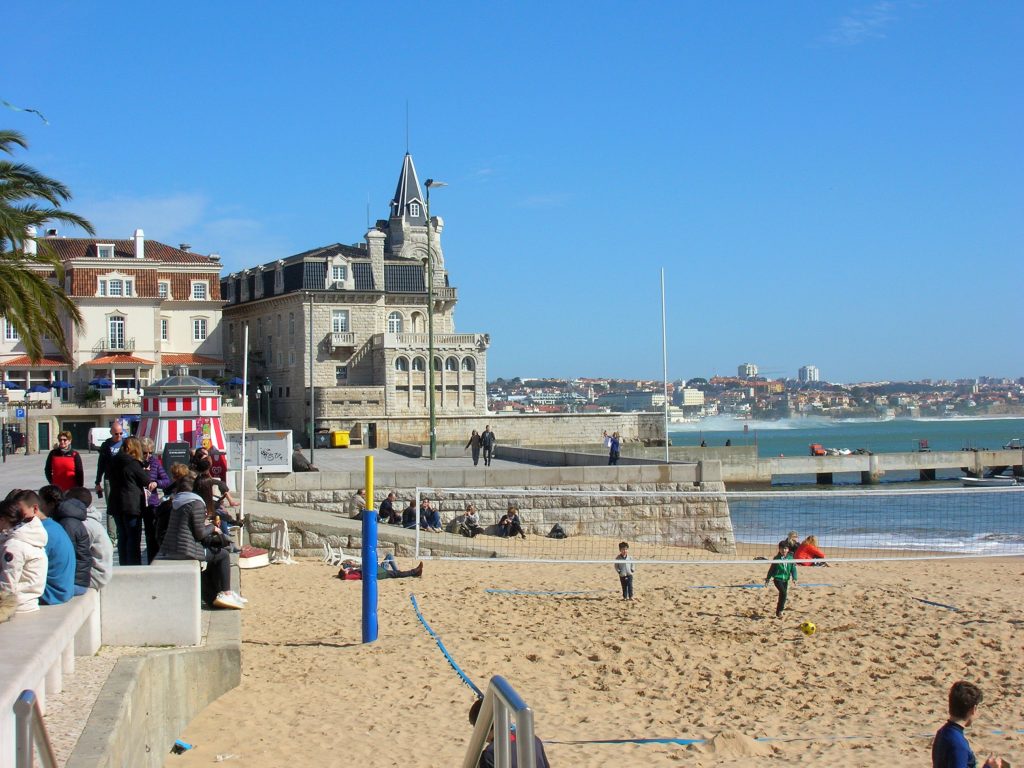
Cascais is the end of the train line and the most complete day out of the three. It is a working fishing town that became a resort without entirely losing the first part, so there is a proper old centre with a market, a fort, a museum quarter and three small beaches inside the town itself. The beaches are modest by Portuguese standards, but the town around them is the draw.
If you are only making one coastal trip, make it this one, and go early. The town fills from late morning with day visitors, and the difference between arriving at half past nine and arriving at noon is substantial. Rent bicycles along the front and ride the flat coastal path north towards Guincho for as long as the children last.
There is far more to the town than its beaches, from the Paula Rego museum to the Boca do Inferno sea cave and the market on Wednesdays and Saturdays. Our separate guide to things to do in Cascais, Portugal covers the town properly if you are planning a full day there rather than an afternoon on the sand.
Staying in Lisbon With the Family?
Casa Almada is a central Lisbon apartment built for families and friends, with flexible sleeping, a full kitchen and the coast train a short walk away.
Book Now4. Praia do Guincho, about 35 km
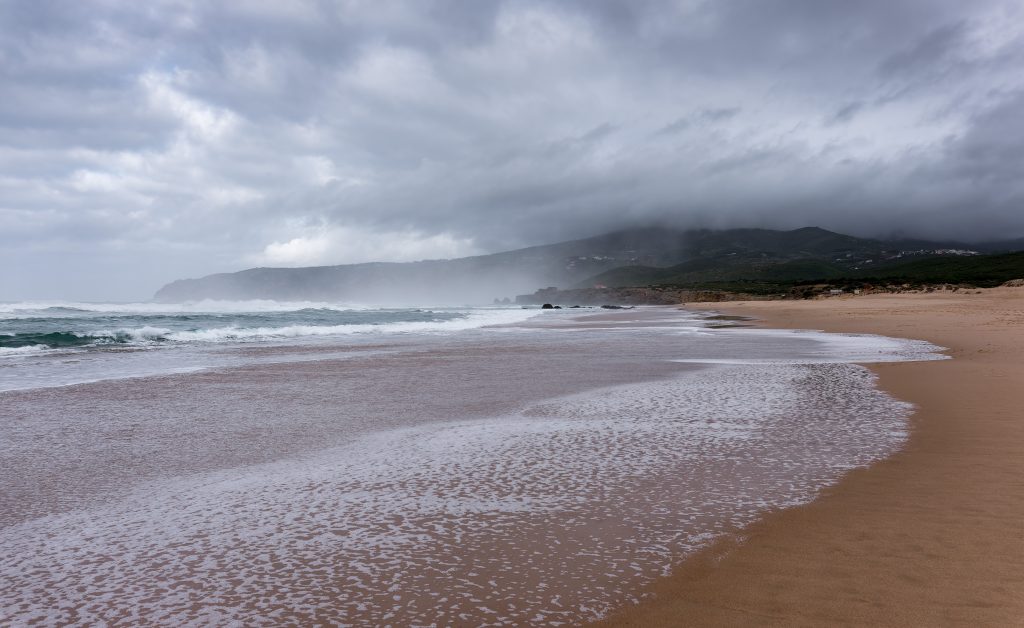
Guincho is the most dramatic beach on this coast and the least suitable for a casual swim. It faces the open Atlantic below the Sintra hills, backed by dunes, and the wind that makes it a world-class windsurfing and kitesurfing spot also makes it uncomfortable for sunbathing on many afternoons. The currents are serious and the water is noticeably colder than at Carcavelos.
Go for the landscape and the seafood rather than to swim, and go in the morning before the wind builds. There is no train, so it is a bus or a taxi from Cascais, which is why it stays quieter than its beauty would suggest. With small children I would choose almost anywhere else on this list, and I say that as someone who thinks it is the best-looking beach near Lisbon.
The hills rising behind the beach are the Serra de Sintra, and the road over them to Sintra and its palaces is one of the best drives in Portugal. If you have hired a car for the day, pairing Guincho in the morning with Sintra in the afternoon is the most efficient use of it, and it is the one combination that genuinely justifies the hire.
5. Costa da Caparica, about 15 km as the crow flies

Caparica is the one most visitors miss, because it is on the wrong side of the river and does not appear on the Cascais train line. It is roughly thirty kilometres of continuous sand running south from the bridge, and because it is so long it never feels crowded in the way the Cascais beaches do in August. The northern end is developed and easy, and it gets progressively wilder the further south you go.
Getting there means crossing the Tagus, either by bus over the bridge or by ferry from Cais do Sodré to Cacilhas and a bus onward, which takes around forty minutes in total. In summer a small narrow-gauge train runs down the length of the beach so you can pick how far from the crowds you want to be. For a family that wants space rather than facilities, this is the best choice near Lisbon.
6. Sesimbra, about 40 km
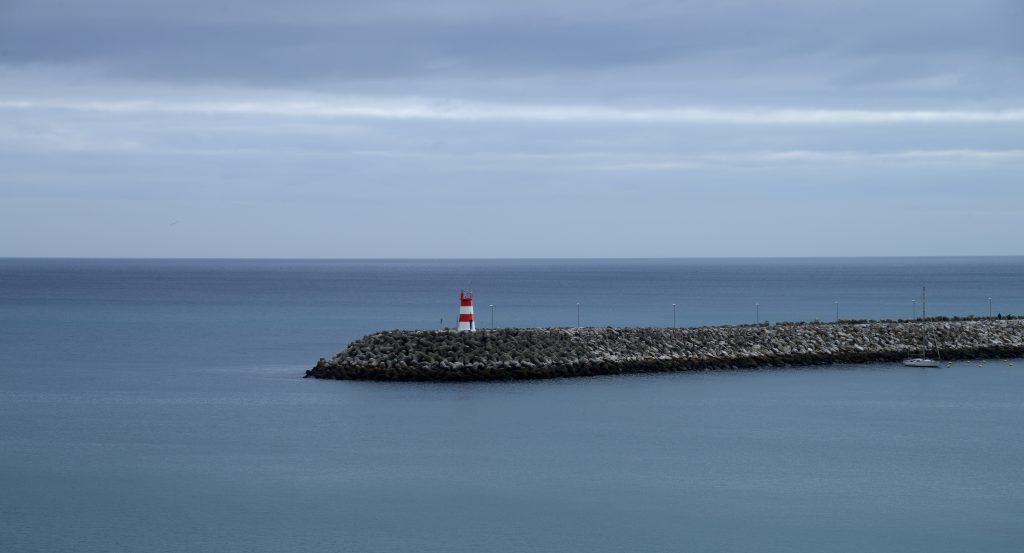
Sesimbra is a fishing town tucked into a south-facing bay below the Arrábida hills, and that orientation changes everything. Sheltered from the Atlantic swell, the water here is calmer and warmer than anywhere on the Cascais side, which makes it the easiest sea on this list for young children and nervous swimmers.
It is also where you eat the best fish near Lisbon, straight off the boats that land in the harbour each morning. The trip is about an hour by bus from Sete Rios, which is longer than the others, so treat it as a full day rather than a morning. Combine it with the Arrábida natural park if you have a car.
Getting to the Lisbon Coast Without a Car
Almost every beach worth visiting on the Cascais side is reachable on one suburban train line, and this is the single most useful thing to understand about the Lisbon coast. The line starts at Cais do Sodré, runs along the water the whole way, and ends at Cascais roughly forty minutes later.
| From Lisbon to | Method | Journey | Notes |
|---|---|---|---|
| Carcavelos | Train, Cais do Sodré | ~30 min | 10 min walk to the sand |
| Estoril | Train, Cais do Sodré | ~35 min | Beach is opposite the station |
| Cascais | Train, Cais do Sodré | ~40 min | End of the line |
| Guincho | Train then bus or taxi | ~50 min | No direct rail |
| Costa da Caparica | Ferry then bus, or bus | ~40 min | Crosses the Tagus |
| Sesimbra | Bus from Sete Rios | ~1 hr | Full day out |
Sit on the left-hand side heading out of the city. The track runs so close to the water for the last twenty minutes that the journey is part of the day rather than a means of getting through it, and guests routinely tell me the train was the bit the children liked most.
A car only becomes worth it for Arrábida and the more remote beaches south of Sesimbra. For everything else it is a liability, because parking at the popular beaches in July and August is genuinely difficult and the train is faster than the coast road on a Saturday.
When to Go, and What the Coast Is Like Each Season
Portugal gets a great deal of sun, but the Atlantic does not warm up the way the Mediterranean does. Sea temperature, rather than air temperature, is what decides whether a beach day works.
| Season | Air | The sea | Verdict |
|---|---|---|---|
| Apr to May | Mild and bright | Cold | Best for walking the coast, not swimming |
| Jun to Jul | Warm | Cool but usable | Long days, beaches filling up |
| Aug | Hot | Warmest of the year | Busiest by a distance, book ahead |
| Sep | Warm | Still warm | The best month overall |
| Oct to Mar | Mild, some rain | Cold | Empty beaches, seafood, no swimming |
September is the answer for most people. The sea has had all summer to warm up, the August crowds have gone home, and the coast train is no longer standing room only. If you are travelling with school-age children and tied to August, go early in the morning and pick Caparica over Cascais for the space.
July and August also bring the festival season, which pairs unusually well with beach days because the music happens in the evening. Ageas Cooljazz takes place in Cascais itself, so you can spend the day on the sand and stay on for the concert. Our guide to the Lisbon jazz festivals has the 2026 dates for both that and Jazz em Agosto at the Gulbenkian.
One Base, Every Beach on the Line
Rather than committing to one stretch of sand, stay central at Casa Almada and take the coast train out to a different beach each day.
Book NowWhere to Stay for the Lisbon Coast
The decision most people get wrong is basing themselves on the coast. It looks right on a map, and then you spend the week travelling back into Lisbon for everything that is not sand, which is most of what you came to Portugal for. Cascais is a lovely town to spend a day in and an awkward one to spend a week in unless the beach really is the entire trip.
Casa Almada is our answer to that, a central Lisbon apartment designed for families and friends with flexible sleeping, a proper kitchen and walkable access to the city’s main sights. It puts the coast train, the museums and the restaurants all within reach of the same front door, which means beach days happen when the weather is right rather than because you are committed to them.
If your trip is heading further north afterwards, Canto de Luz in Porto is the natural second stop, with a heated pool and the same daily homemade breakfast. For larger parties, the group properties guide sets out what works when there are more than eight of you.
A Guest Review
“Casa Almada is a special place in an exceptional location in the heart of Lisboa, but what really stands out is the extraordinary service we received from Susan and her team. I was traveling with my three young adult children. Susan is a truly special person who clearly cares whether her guests are comfortable and happy. I’m so happy we found this gem. Thank you, Susan for helping to provide an amazing experience.”
Michele — stayed at Casa Almada, Lisbon

A Note From Susan
“Guests arrive convinced they have to choose between the city and the sea, and every time I tell them the same thing. Get the train. It costs almost nothing, it runs along the water, and you can be swimming forty minutes after you leave the apartment. You do not have to give up Lisbon to have a beach holiday here.”
More to Explore
For the city itself, start with our guide to the best areas and neighbourhoods in Lisbon, and for a day inland the Sintra guide covers the palaces an hour from the coast. If your trip continues north, our guide to Fado in Porto covers the history and the best places to hear it. The full collection of properties covers Portugal, Spain, Malta and the UK.
Frequently Asked Questions
Does Lisbon Have A Beach?
Not inside the city. Lisbon sits on the Tagus river several kilometres from the Atlantic, so the waterfront at Belem and Cais do Sodre is river rather than sea. The nearest proper beach is Carcavelos, about 18 km west and roughly 30 minutes by train.
What Is The Closest Beach To Lisbon?
Carcavelos, at about 18 km. It is a wide sandy beach with a shallow entry, a promenade of cafes and surf schools at the western end. The train from Cais do Sodre takes around 30 minutes and the station is a 10 minute walk from the sand.
How Far Is Lisbon From The Beach?
Between 15 and 50 km depending which beach you choose. Carcavelos is about 18 km and 30 minutes by train, Cascais about 30 km and 40 minutes, and Costa da Caparica about 15 km as the crow flies but roughly 40 minutes because you cross the Tagus.
How Do You Get To The Beach From Lisbon?
Take the Cascais suburban line from Cais do Sodre, which runs along the coast and stops at Carcavelos, Estoril and Cascais. Trains run roughly every 20 minutes and the whole line takes about 40 minutes end to end. For Costa da Caparica, take the ferry across the river or a bus over the bridge.
Which Beach Near Lisbon Is Best For Families?
Carcavelos for convenience, with its shallow entry and 30 minute train, or Sesimbra for the calmest water, because its south-facing bay is sheltered from the Atlantic swell. Avoid Guincho with young children, where the wind and currents are genuinely strong.
Is The Sea Cold Near Lisbon?
Yes, colder than most people expect. This is the open Atlantic, not the Mediterranean, and it is bracing even in August. August and September are the warmest months for swimming, and Sesimbra is the warmest water near Lisbon because of its sheltered position.
Do You Need A Car For The Lisbon Coast?
No, for almost everything. The Cascais train line reaches five beach towns and is faster than the coast road in summer. A car is only worth it for Arrabida and the remoter beaches south of Sesimbra, and parking at the popular beaches in July and August is difficult.
When Is The Best Time To Visit The Lisbon Coast?
September. The sea has had all summer to warm up, the August crowds have gone and the coast train is comfortable again. August has the warmest water but is by far the busiest, and April to May is better for walking the coast than for swimming.
Should You Stay On The Coast Or In Lisbon?
In Lisbon, for most trips. Basing yourself on the coast ties you to one beach and means travelling back into the city for museums, restaurants and everything else. Staying central and taking the 30 to 40 minute train out gives you every beach on the line plus the city.
Your Lisbon Base for a Coast and City Trip
Casa Almada is a luxury apartment in the heart of Lisbon, built for families and friends, with flexible sleeping, a full kitchen and the coast train a short walk from the door.
Book NowImage credits: Cascais bay, Photo: Herbert wie, CC BY-SA 4.0. Praia do Guincho, Photo: Jules Verne Times Two, CC BY-SA 4.0. Costa da Caparica, Photo: Alvesgaspar, CC BY-SA 3.0. Sesimbra, Photo: Alvesgaspar, CC BY-SA 4.0. Carcavelos, Photo: Sonse, CC BY 2.0. All via Wikimedia Commons.